
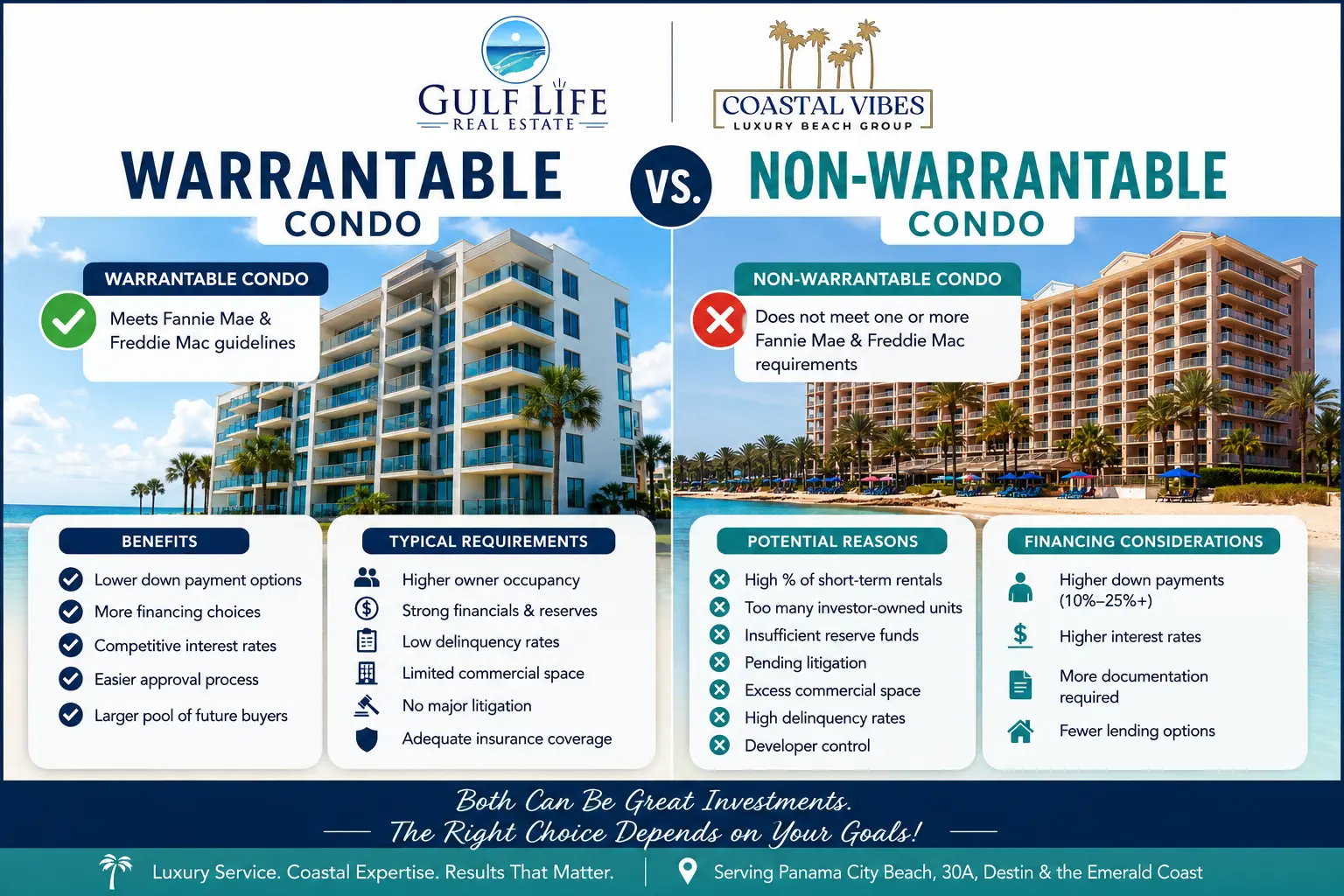
Warrantable vs. Non-Warrantable Condos:
What Every Buyer Should Know
By Coastal Vibes Luxury Beach Group | Powered by Gulf Life Real Estate
If you're shopping for a condo along the Emerald Coast, you've probably heard the terms "warrantable" and "non-warrantable." While they may sound complicated, understanding the difference can save you time, money, and frustration during the financing process.
Whether you're buying a primary residence, second home, or investment property, here's what you need to know.
What Is a Warrantable Condo?
A warrantable condo is a condominium that meets the lending guidelines established by Fannie Mae and Freddie Mac. Because these properties meet certain financial and ownership requirements, most conventional lenders are comfortable financing them.
Benefits of a Warrantable Condo:
✔ Lower down payment options
✔ More financing choices
✔ Competitive interest rates
✔ Easier approval process
✔ Larger pool of future buyers when you decide to sell
Common Requirements for a Warrantable Condo
While guidelines can vary, lenders generally look for:
Owner Occupancy
A healthy percentage of units must be owner-occupied or second homes rather than investor-owned.
Financial Stability
The condo association should have adequate reserves and maintain a sound budget.
Insurance Coverage
The association must carry proper insurance coverage for the property.
Delinquency Limits
Too many owners cannot be behind on association dues.
Commercial Space Restrictions
The amount of commercial space within the development must remain within acceptable limits.
Litigation Concerns
The association should not be involved in significant unresolved lawsuits that could affect the property's value.
What Is a Non-Warrantable Condo?
A non-warrantable condo does not meet one or more of the requirements established by Fannie Mae or Freddie Mac.
That does not mean it's a bad property. In fact, many beachfront and resort-style condos on the Emerald Coast are considered non-warrantable.
However, financing options can be more limited.
Why a Condo May Be Non-Warrantable
A condo may be classified as non-warrantable if:
🔹 Too many units are used as short-term rentals
🔹 A single owner owns too many units
🔹 The association has insufficient reserve funds
🔹 There is pending litigation involving the association
🔹 Commercial space exceeds lender guidelines
🔹 Too many owners are delinquent on association dues
🔹 The project is still under developer control
Financing a Non-Warrantable Condo
Financing is still possible, but buyers may encounter:
Higher Down Payments
Many lenders require 10%–25% down, depending on the project.
Higher Interest Rates
Rates are often slightly higher due to increased lender risk.
Additional Documentation
Lenders may require more extensive reviews of the association's financials, insurance, and governing documents.
Fewer Lending Options
Not all lenders offer non-warrantable condo financing.
Why This Matters for Investors
Many of the Emerald Coast's most desirable vacation rental communities are classified as non-warrantable because of their strong short-term rental activity.
For investors, this can actually be a positive sign because it often indicates:
🏖 Strong vacation rental demand
🏖 High occupancy rates
🏖 Attractive income potential
🏖 Prime beachfront locations
The key is working with a lender experienced in non-warrantable condo financing.
Before You Make an Offer
Before falling in love with a condo, ask:
✔ Is the condo warrantable or non-warrantable?
✔ What financing options are available?
✔ What are the HOA fees?
✔ Are there any upcoming assessments?
✔ Are short-term rentals allowed?
✔ What do the association's financials look like?
Getting these answers early can help avoid surprises later in the transaction.
The Bottom Line
Both warrantable and non-warrantable condos can be excellent opportunities. The best choice depends on your goals, financing strategy, and how you plan to use the property.
A warrantable condo may offer easier financing and broader resale appeal, while a non-warrantable condo may provide stronger vacation rental potential and access to highly sought-after beachfront communities.
If you're considering purchasing a condo along Panama City Beach, 30A, Destin, or anywhere along Florida's Emerald Coast, our team can help guide you through the process and connect you with lenders who specialize in both warrantable and non-warrantable financing.
Coastal Vibes Luxury Beach Group
Powered by Gulf Life Real Estate
📍 Serving Panama City Beach, 30A, Destin, Santa Rosa Beach, and the Emerald Coast
🌴 Luxury Service. Coastal Expertise. Results That Matter.
Frequently Asked Questions
Why do i need to know what the difference is between warrantable and non warrantable condos
Knowing whether a condo is warrantable or non-warrantable affects: 🏦 Financing – Loan approval may be easier or harder. 💰 Down Payment – Non-warrantable condos often require more money down. 📉 Interest Rates – Warrantable condos usually qualify for better rates. 🏖️ Investment Potential – Many vacation rental condos are non-warrantable. 📈 Resale Value – Warrantable condos often appeal to a larger pool of buyers. Bottom Line: Before making an offer, always find out if the condo is warrantable or non-warrantable so there are no surprises with financing or costs
Do all lenders finance both?
No. Not all lenders finance both warrantable and non-warrantable condos. ✅ Most lenders will finance warrantable condos because they meet Fannie Mae and Freddie Mac guidelines. ⚠️ Non-warrantable condos require specialty financing, and only certain lenders offer those loan programs. These loans often come with: Higher down payments Slightly higher interest rates Additional condo review requirements On the Emerald Coast, many popular vacation rental condos are non-warrantable, so it's important to talk with a lender before making an offer. Bottom Line: Always find out if the condo is warrantable or non-warrantable first, then make sure your lender can finance that specific property. It can save you a lot of time and prevent surprises during the loan process. 🏖️🏡💰


